Schiff: “The simple truth is that this administration has no idea how or when this war will end. It is hard to end a war when you are not clear on why you began it.”
Washington, D.C. – Today, a majority of Senate Republicans again voted to block a resolution to end President Trump’s illegal war in Iran sponsored by U.S. Senators Adam Schiff (D-Calif.), Tammy Duckworth (D-Ill.), Tammy Baldwin (D-Wis.), Cory Booker (D-N.J.), Tim Kaine (D-Va.), Chris Murphy (D-Conn.), Jeff Merkley (D-Ore.), Kirsten Gillibrand (D-N.Y.), Chris Van Hollen (D-Md.), Mark Kelly (D-Ariz.), Raphael Warnock (D-Ga.) and Andy Kim (D-N.J.).
This is the fourth resolution, this one led by Duckworth, the Senators have forced a vote on since the beginning of the war.
“We are now in the second month of Trump’s Iran War, and the president has offered no proposal to even authorize the use of force in Iran, nor have Republicans demanded one. We have not had a single open hearing on the war, nor have Republicans called for one. The case for the war in Iran has never been made, will never be made and my colleagues will not put the matter to a vote, for fear they will lose that vote or be held accountable for it. How long can this go on? And the short, terrible, answer is — for a very long time. It is beginning to have all of the tell-tale signs of a quagmire,” said Senator Schiff on the Senate floor.
“We can only be certain of one thing — at some point, the president will claim victory, but what kind of a victory will it be? One in which, Iran, for the first time, can demand tolls from ships passing through Hormuz? One in which the regime has survived, and, empowered and embittered, is even worse, with more crackdowns on the Iranian people, even less tolerant of dissent, or worse still, with a fervent desire to breakout and build a bomb? One in which we suffer persistent and higher gas prices because of long term damage has been done to gulf oil and gas infrastructure? One in which Russia is richer and will be richer for the foreseeable future from the higher oil prices it can charge so that it can better fund its war with Ukraine?”the Senator continued.
These war power votes follow the Senators’ demands that Republican Majority Leader John Thune (R-S.D.) ensure the relevant committees of jurisdiction in the Senate hold immediate public hearings on the administration’s unconstitutional war in Iran. The Senators demanded they will use these resolutions to force debate and additional votes if Republican leadership does not arrange public committee hearings with Secretary of State Marco Rubio and Secretary of Defense Pete Hegseth.
Last June, the Senate voted on a similar War Powers Resolution introduced by Kaine and Schiff to prevent the use of military force against Iran unless explicitly authorized by Congress. The June resolution gained bipartisan support but did not receive enough votes to advance.
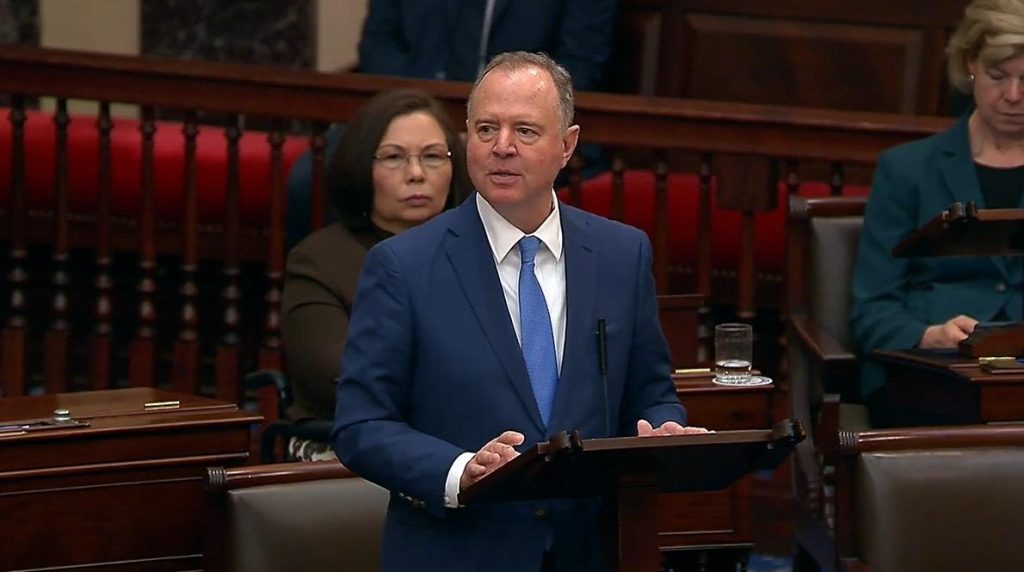
Watch his full speech HERE. Download remarks HERE.
Read the full transcript of his remarks as delivered below:
We are now in the second month of Trump’s Iran War, and we have already, tragically, lost 13 servicemembers, including one, Chief Warrant Officer Robert Marzan, from my home state of California.
We are now in the second month of Trump’s Iran War, and more than 200 U.S. servicemembers have been injured, some, very seriously.
We are now in the second month of Trump’s Iran War, and we have already had two American pilots shot down over Iran, necessitating a rescue under extremely dangerous conditions. A heroic rescue, a daring rescue, and one that was only possible because we have the most capable special forces in the world. But a rescue mission that we must all acknowledge put an incredible number of our servicemembers at grave risk and could have easily gone wrong.
We are now in the second month of Trump’s Iran War, and we have squandered tens of billions of dollars that could have been used to build hospitals and affordable housing, to build childcare centers and senior centers. At a time when the president says we can’t afford daycare, Medicare, or Medicaid.
We are now in the second month of Trump’s Iran War, and Americans are paying astronomical prices at the gas pump, at the grocery store, on their utility bills and medical bills, but the president’s actions — and inaction — are only making life more unaffordable for our citizens.
We are now in the second month of Trump’s Iran War, and the president has offered no proposal to even authorize the use of force in Iran, nor have Republicans demanded one. We have not had a single open hearing on the war, nor have Republicans called for one. The case for the war in Iran has never been made, will never be made and my colleagues will not put the matter to a vote, for fear they will lose that vote or be held accountable for it.
How long can this go on? And the short, terrible, answer is — for a very long time. It is beginning to have all of the tell-tale signs of a quagmire.
For this war had no clear purpose. It had no well-defined goal. It had no strategic plan. Its rationale has shifted endlessly with the wind and the whims of the president. It has vacillated between being about regime change and then not about regime change. About missiles and then not about missiles. About oil and then not about oil. About Iran’s nuclear threat, and then not about its nuclear threat, since the president had said that Iran’s nuclear program had been obliterated a year ago. Ironically, the administration’s nuclear end game now sounds a lot like the JCPOA, the much-maligned agreement that Trump tore up and now seems reconciled to embrace, the JCPOA or something like it.
Iran has blockaded the Strait of Hormuz — sending oil prices skyrocketing — and now the vice president says “two can play at that game” so we are in the blockade business too. How does that help the American family that can’t afford to fill up the car, the trucker put out of work, or the farmer with no fertilizer?
The simple truth is that this administration has no idea how or when this war will end. It is hard to end a war when you are not clear on why you began it.
We can only be certain of one thing — at some point, the president will claim victory, but what kind of a victory will it be? One in which, Iran, for the first time, can demand tolls from ships passing through Hormuz? One in which the regime has survived, and, empowered and embittered, is even worse, with more crackdowns on the Iranian people, even less tolerant of dissent, or worse still, with a fervent desire to breakout and build a bomb? One in which we suffer persistent and higher gas prices because of long term damage has been done to gulf oil and gas infrastructure? One in which Russia is richer and will be richer for the foreseeable future from the higher oil prices it can charge so that it can better fund its war with Ukraine?
Is this the victory that Trump will declare? One for which we have paid dearly in blood and treasure? One for which he will cut health care to pay $200 billion more for defense, to replenish the stocks of the weapons that he has used.
Does that sound like victory? Does that feel like victory?
In 1984, at the height of the Cold War, Ronald Reagan said this:
“History teaches that wars begin when governments believe the price of aggression is cheap.”
Sadly, the lessons of that history have come to pass. And they have come to pass in the form of a president who now, too often, sees aggression as cheap.
As he has launched not one, but two wars against Iran.
As he has launched unilateral strikes in South America, and in Africa.
As he has overseen a war on vessels in the Caribbean and the Eastern Pacific.
As he has blockaded Cuba and threatens to “take” it, along with Greenland.
To Donald Trump, war has become easy. It has become a kind of default. And as a result, he has become the president he promised he would never be — far from his promise to end wars, he is now the president determined to start them. And lots of them.
The Founding Fathers warned us of a man like this — a president grown too fond of war. Seduced by the quick success of the apprehension of Maduro in Venezuela, and of the access to another country’s oil that such an operation begat, he was induced to make war against Iran. But Iran is not Venezuela. And the son of the Ayatollah is no Delcy Rodríguez, not another pliant regime figure to be easily manipulated.
In the same speech Reagan also said this:
“To keep the peace, we and our allies must be strong enough to convince any potential aggressor that war could bring no benefit, only disaster.”
This is peace through strength, his most famous mantra in foreign policy.
Well, what is the strength of our alliances now? The president has turned our back on the security pacts that Reagan championed, like NATO. He has failed to consult with our allies before embarking on this war of choice, then claimed we didn’t need allies, then complained when our allies did not come to our assistance in reopening a strait that previously had been open but now is closed.
The president has undermined our credibility with friend and foe alike, as he threatens to end a civilization and to commit war crimes, or as he ordered military strikes while talks were ongoing, or as ‘two more weeks’ becomes a kind of punchline.
And what have we taught Iran — the “ostensible aggressor” in Ronald Reagan’s formulation. Have we taught Iran that war can bring no benefit? Or is Iran now convinced it can bring the world economy to its knees and impose its will by imposing fees on passage through the Strait of Hormuz?
Does it believe that while the U.S. military can pound its navy and missile sites, it can still strike U.S. targets and our partners in the region with rockets and drones? Does it believe it has an asymmetric advantage over the U.S. because drones and missiles are cheap and interceptors are expensive?
Ronald Reagan will be right, that we have convinced the aggressor that war can bring no advantage only disaster, if, in fact, it is we who are the aggressor.
This war should never have begun.
And it is long time for the U.S. Congress to put an end to it.
###