Schiff: “We are not powerless. Not us here in this body. Not those in America who have the most important title in a democracy, that of citizen. […] We can rebuild a country where every child has a fair shot, and hard work leads to a good life”
Washington, D.C. – Today, Senator Adam Schiff (D-Calif.) delivered his maiden speech, the first major address on the Senate floor for new Senators, where he laid out his record of delivering for Californians by fighting to lower costs and ensure the economy works for everyone, improving disaster resiliency and rebuilding in the wake of the Southern California wildfires, and defending democracy and the rule of law. The speech comes on the heels of Senator Schiff marking his one-year anniversary since being sworn into office.
In his speech, Senator Schiff underscored that in his first year in office he has been committed to serving all Californians, including visiting nearly half of counties across the state, and that he will continue to work with anyone and seize any opportunity to make Americans’ lives better. Senator Schiff also highlighted how the strength of our democracy and the strength of our economy are interconnected, and that is why we must make sure that all Americans who work hard can earn a good living to support their families. He also laid out his vision for how Congress must be delivering for Americans by being a force for progress: bringing down costs, jumpstarting a housing boom, and preparing our country to thrive in the world of AI and automation.
Yesterday, to mark the anniversary of his first year in office, Senator Schiff released a video highlighting his record of wins for California.
Read a summary of the Senator’s first year in office here.
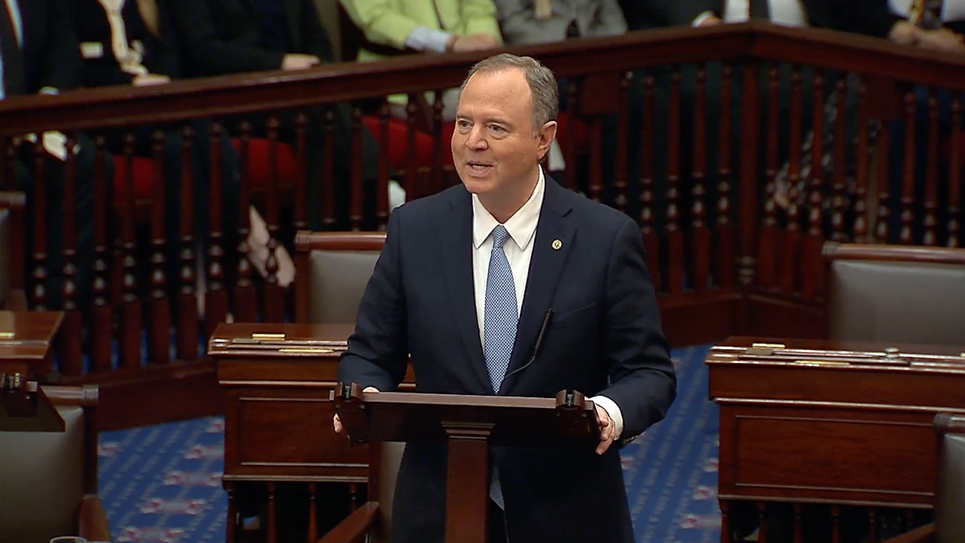
Watch the full clip HERE. Download the clip HERE.
Key Excerpts:
On his commitment to being a Senator for all Californians and working with anyone to deliver results on our toughest challenges:
[…] I intend to be a Senator for all Californians. In the red areas and the blue, and everywhere else in between. That’s one reason I sought to join the Senate Agriculture Committee — the first time in more than 30 years that our nation’s largest agriculture producing state has had a seat at that table.
I have traveled the state on planes, trains, automobiles, and even boats, visiting nearly half of California’s 58 counties — including some of the most conservative parts of our state. I’ve toured almond orchards and cilantro fields, health clinics and food banks and affordable housing developments. I even took part in an ill-advised game of dice at a bar in Los Baños — while drinking a bitter Dutch liqueur — which I will not be repeating. Wherever I go, I’ve asked Californians the same question: how can I help?
[…] I am a proud Democrat. But I’m also willing to work with anyone to advance those efforts. Including that guy at the other end of Pennsylvania Avenue who doesn’t care for me very much, and who I’m not particularly fond of either. Because life is too short, and the problems are too great, not to seize every opportunity to make progress.
On fighting to ensure the economy works for everyone:
[…] The health of our democracy and the strength of our economy are deeply entwined. We cannot have a strong economy without a strong democracy. And we cannot have a strong democracy, if we cannot answer in the affirmative, the most basic, the most vital and central question facing American families, and that question is this: If you are working hard in America, can you still earn a good living for yourself and your family?
To answer that question — yes — means putting a relentless focus on the basic needs of our constituents, food, housing, healthcare, a good job, and the dignity that comes with work. It means acknowledging our own failures of leadership and governance — and calling out corruption wherever we see it. It means placing a renewed focus on getting stuff done. As it so often has, I believe that California is showing the way again.
On his vision for how Congress must deliver for the American people:
[…] Let’s act anew to jumpstart the next housing boom in America — as we did for returning GIs after World War II, as legislation I’ve just introduced would do — so that every family can afford a roof over their heads.
Let’s find ways to bring down costs — on groceries, on electricity, on child care — so that a living wage means something again in America.
Let’s educate and prepare Americans to thrive in a world of AI and automation, while continuing to advance America’s technological edge.
Let’s put forward a real vision for a fair and humane immigration system that attracts the world’s hardest workers, brightest minds, and best hearts. And retains them, rather than kicks them out.
Let’s act — not just to prevent the closure of rural hospitals and labor and delivery rooms — but to expand access to affordable, quality health care for all.
In so doing, let us demonstrate to the American people that Congress need not be the opposite of progress.
On his focus on protecting our democracy and standing up to those who threaten it:
[…] There is nothing inexorable about democracy. The moral arc of the universe is long, and it bends towards justice, but not on its own, not without effort, not without sacrifice, and not at the present moment. If we are to preserve this great, this improbable experiment in self-governance, our press must remain free from coercion. Our universities must be free to teach, our law firms to take on unpopular clients, our justice department to do impartial justice, our companies to hire the best talent, our legislators to vote their conscience without fear of violence or reprisal.
Read the full transcript of his remarks as delivered below:
Almost six years ago, I stood here on the Senate floor. I was not yet a member of this body and spoke as a House member leading President Trump’s first impeachment. “‘We are not enemies,’” I said, quoting Lincoln, “‘but friends. We must not be enemies.” “If Lincoln could speak these words during the civil war,” I observed, “surely we could say them and mean them now.”
In the six years since that impeachment, our country has only become further divided. It has become even more challenging for Americans to speak with each other, with our neighbors, even with members of our own families who have been alienated from one another.
How we begin to heal our present wounds and bring about the sense of common purpose that has been lost, it is difficult to say, as the causes of our division are many. But I suspect, if there is a common denominator to what must be done, it begins with a renewed effort to better understand each other, who we are, where we come from, what drives us.
In that spirit, let me tell you a little about who I am that may differ from the version many Americans see on Fox, or in the President’s social media feed, and what I have done to introduce myself to my 40 million new constituents.
Because I intend to be a Senator for all Californians. In the red areas and the blue, and everywhere else in between. That’s one reason I sought to join the Senate Agriculture Committee — the first time in more than 30 years that our nation’s largest agriculture producing state has had a seat at that table.
I have traveled the state on planes, trains, automobiles, and even boats, visiting nearly half of California’s 58 counties — including some of the most conservative parts of our state. I’ve toured almond orchards and cilantro fields, health clinics and food banks and affordable housing developments.
I even took part in an ill-advised game of dice at a bar in Los Baños — while drinking a bitter Dutch liqueur — which I will not be repeating.
Wherever I go, I’ve asked Californians the same question: how can I help?
Now it is certainly true, depending on where I am in the Golden State, that sometimes I have to break through the caricatures of me on right-wing media, and that can be a challenge. But it is one I very much enjoy. There is nothing more fun in politics than upsetting people’s expectations.
I knew, for example, that I was making progress when a farmer in conservative Butte County told me after an hour-long meeting: “I don’t know why the President calls you ‘watermelon head.’ You have a perfectly normal size head!”
And that comes from a farmer who knows a thing or two about melons.
Traveling across California has only underscored that it is the honor of a lifetime to serve the state I so deeply love in the Senate.
I’m especially humbled to serve alongside my friend and colleague, Alex Padilla, and to follow in the footsteps of trailblazing giants who have gone before us — Dianne Feinstein, Barbara Boxer, and our own Madam Vice President, Kamala Harris, in whose Hart office I now sit.
I’m grateful beyond measure to my staff — the smartest, hardest-working, best-looking bunch of public servants in America — whose dedication to the people of California inspires me every day.
And, of course, I am deeply grateful to my family:
My strong, loving, daring, and caring wife Eve… yes, we are Adam and Eve.
My children Lexi and Eli, of whom I’m so immensely proud…
My late parents, Ed and Sherrill who taught me everything important…
And my brothers, Daniel and David.
Like so many Americans, I owe who I am to my family. And my family owes who we’ve become to the opportunities this country has afforded us. My parents, Ed and Sherrill, were the grandchildren of immigrants from Eastern Europe, from Lithuania and Poland, and as my parents used to say with pride — from the Shtetl to the Congress in three generations — only in America.
My father, Ed, left high school early to join the military at the end of World War II. He tried to enlist in the Marine Corps but failed his physical — flat feet and bad eyesight.
Two weeks later, he tried to enlist in the Army. Thinking there might be a different physical standard. Or, at least, a different examining physician. As it turned out, it was the same standard. And the same damn physician.
“Wait, weren’t you here two weeks ago?” the doctor asked.
My father said, “yes.”
“You really want to get in that bad?”
My father said “yes.”
And just like that, Ed Schiff was in the U.S. Army.
After he left the service, my father went to college on the GI bill. He later dropped out, one of the few decisions in life he came to regret and went into the Schmatta business — that’s Yiddish for selling clothing or rags — and sold Schmatta up and down New England.
Eventually, he got promoted, and moved our family from Framingham, Massachusetts… to Scottsdale, Arizona… and, finally, to Alamo, California.
We went from working class to middle class, my father eventually getting out of the clothing business and buying a lumber yard. I grew up like so many other kids in that era: with Little League, Cub Scouts, and lemonade stands — my mother ringing a cow bell to let us know when it was dinnertime. The sonorous, authoritative voice of Walter Cronkite on the TV. And summers spent working in restaurants or hauling sacks of concrete and roofing materials.
We lived the booms and busts of the 1970’s and 1980’s. At times, my father would tell us that his business was growing so fast it was scary. At other times, that we all needed to tighten our belts to make it through the next few years.
But because this is America — because my family settled in the Golden State in the 1970’s — I was able to attend some of the finest K12 public schools in the country. And that has made everything possible.
I was able to become a prosecutor with the U.S. Attorney’s Office in Los Angeles, and take on everything from drug trafficking to corruption, to Russian spies. That included prosecuting Richard Miller, the first FBI agent ever indicted for espionage — and my first introduction into the insidious influence of the Russian government.
And I was able to win elected office. Not on my first try. Not even on my second. But third time is the charm, and for three decades now I have had the great privilege to serve the people of California — in the state senate, in the U.S. House, and now in this august chamber.
So many of us who grew up in the postwar era share a common experience.
We entered a dynamic, growing economy — one that had its ups and downs, and its winners and losers — but still an economy that allowed millions to climb into — and stay in — the middle class.
We benefitted from vibrant democratic institutions that — despite their many flaws and blind spots — upheld the rule of law and steadily improved the quality of people’s lives.
In so many ways, California embodies that limitless future. Exciting, entrepreneurial. Home to Silicon Valley and aerospace and Hollywood. To Disneyland and redwoods reaching the skies. The shores to the Mountains. I can still remember the wonder in my friends’ eyes when I announced I’d be moving to that Golden State.
Yet that California — that America — the America that made my story and so many others possible — is today under grave threat.
What was once a sturdy ladder into the middle class, now feels more like splintered wood.
My parents bought our first home for $18,000 — what my father earned in single year as a clothing salesman. These days, in most parts of California, that wouldn’t cover six month’s rent. The notion of buying a place for a year’s salary is a fantasy for all but a tiny handful of the wealthiest Americans.
When my brother, Dan, entered UC Berkeley in 1976, tuition cost practically nothing. A couple hundred bucks in registration fees, another couple hundred for books, maybe $1,000 for room and board. That was the cost to attend what even I — a graduate of Cal’s rival from across the Bay — must grudgingly admit is one of the best universities in the world.
Today, attending that same institution will cost you upwards of $50,000 a year.
I hear from Californians every day who are struggling, one health problem or car problem away from failure. The exhaustion. The desperation. The pride they take in their work — and the despair that it never seems to be enough.
The man in San Diego who wrote to me, telling me he’ll have to spend thousands of dollars more a year just to keep his health coverage. Or he may have to drop it completely.
The young woman in the north state who did everything right, got a good education and has a mountain of debt to show for it — and who told me, in tears, how she is deathly afraid of getting sick because she can’t afford it, how she has nothing set aside for retirement, and nothing to set aside.
The farmworkers in the Central Valley who are afraid to go to work or attend church lest ICE detain them, citizens and noncitizens alike.
Is it any wonder so many Americans believe the system no longer works for them? That hard work is no longer a guarantee of a good life?
That sense for the first time in our history and for millions of Americans, that their parents’ life was better, that their children’s future is in doubt, is a powerful and destabilizing force. Because when our economy stops working, our democracy stops working.
We’ve seen this movie before. Over and over again.
In college, I travelled behind the Iron curtain. As a young Department of Justice lawyer assigned to work in Czechoslovakia, I saw up close how an autocrat could exploit profound economic dislocation and inequality to divide and dominate. As a Member of Congress, I have witnessed civil society activists fighting oppressive regimes around the world which impoverished their own people even as they enriched themselves.
When the political system that’s supposed to address economic challenges proves itself incapable or indifferent, too many people become susceptible to the siren song of any demagogue who insists that they alone can fix it.
And so we come to this perilous moment. When so many of our expectations have proved incorrect.
We who watched walls coming down, new democracies being born, more people able to practice their faith, associate with whom they would and able to speak their piece, we came to believe that freedom would be forever on the march. That it was inevitable. Inexorable. Irrevocable.
We were wrong.
There is nothing inexorable about democracy. The moral arc of the universe is long, and it bends towards justice, but not on its own, not without effort, not without sacrifice, and not at the present moment.
If we are to preserve this great, this improbable experiment in self-governance, our press must remain free from coercion. Our universities must be free to teach, our law firms to take on unpopular clients, our justice department to do impartial justice, our companies to hire the best talent, our legislators to vote their conscience without fear of violence or reprisal.
The health of our democracy and the strength of our economy are deeply entwined. We cannot have a strong economy without a strong democracy. And we cannot have a strong democracy, if we cannot answer in the affirmative, the most basic, the most vital and central question facing American families, and that question is this:
If you are working hard in America, can you still earn a good living for yourself and your family?
To answer that question — yes — means putting a relentless focus on the basic needs of our constituents, food, housing, healthcare, a good job, and the dignity that comes with work.
It means acknowledging our own failures of leadership and governance — and calling out corruption wherever we see it.
It means placing a renewed focus on getting stuff done.
As it so often has, I believe that California is showing the way again.
In the resurgence of San Francisco under a mayor who has prioritized results over ideology.
In Los Angeles, where communities are coming together to rebuild from the ashes.
In San Jose’s data-driven governance.
In Sacramento and Oakland and San Diego — taking real action on homelessness, transit and housing.
In the Central Valley, the Imperial Valley and the North State, growing the food that nourishes us, pressing on despite the hardship of not enough water and too many tariffs.
Each of us, I’m sure, can point to places in our own states and our cities that are addressing real challenges with the seriousness, creativity, and urgency they deserve.
So here in Washington, let us take our cue from the communities we’re privileged to represent.
Let’s act anew to jumpstart the next housing boom in America — as we did for returning GIs after World War II, as legislation I’ve just introduced would do — so that every family can afford a roof over their heads.
Let’s find ways to bring down costs — on groceries, on electricity, on child care — so that a living wage means something again in America.
Let’s educate and prepare Americans to thrive in a world of AI and automation, while continuing to advance America’s technological edge.
Let’s put forward a real vision for a fair and humane immigration system that attracts the world’s hardest workers, brightest minds, and best hearts. And retains them, rather than kicks them out.
Let’s act — not just to prevent the closure of rural hospitals and labor and delivery rooms — but to expand access to affordable, quality health care for all.
In so doing, let us demonstrate to the American people that Congress need not be the opposite of progress.
That red tape and bureaucracy need not be the reason vital housing goes unbuilt and small businesses go under.
That — whether an American lives on the coasts or the heartland, in places that voted for us or against us — we see and hear them… and that their voices carry more weight than a lobbyist checkbook.
I am a proud Democrat. But I’m also willing to work with anyone to advance those efforts. Including that guy at the other end of Pennsylvania Avenue who doesn’t care for me very much, and who I’m not particularly fond of either. Because life is too short, and the problems are too great, not to seize every opportunity to make progress.
Believe it or not, I was born bipartisan.
On my dad’s side, I’m the son of Roosevelt Democrats.
On my mom’s side, the grandson of a Republican county chair who really did Like Ike.
Long before I became one of the Democrats that Republicans love to hate, I chaired the Judiciary Committee in the California State Senate. As Chairman, I encouraged members not to sit by party. We considered every bill referred to committee — whether it was introduced by a Democrat or a Republican. We voted alphabetically, not by seniority. We tried, in other words, to put problem-solving above partisanship.
As a House member, I quickly learned this wasn’t the way in Washington. The first time I voted at odds with my party in committee, the ranking member positively levitated out of his seat before storming over and screaming at me in the middle of the hearing room.
I told constituents after that experience that the quickest way to power and influence on the hill was to eat right, exercise, and outlive the bastards.
But it doesn’t have to be that way.
When I joined this chamber, I was gratified that a number of Republican colleagues reached out to reassure me they would help California receive the aid we need to recover from this year’s devastating wildfires.
In fact, the very first bill I introduced into the Senate was alongside Senator Sheehy — who knows a little bit about fighting fires — to provide tax credits so folks can protect their homes against wildfires and other disasters.
I’ve been proud to champion legislation alongside so many of my Republican colleagues.
So yes, you may have first met me standing on this floor as an impeachment manager. And when this President transgresses the Constitution… or puts forward nominees I consider beyond the pale… uses the military to kill survivors at sea, or tries to rip away Medicaid from our most vulnerable, you will find me right here, standing up to him and standing up for the values I cherish and the people I was elected to serve.
But to anyone serious about solving real problems — no matter which side of the aisle — you will find in me a willing partner.
After all, isn’t that why we chose public service?
Isn’t that why we were sent here?
To make life better for the people we represent?
My purpose was summed up for me decades before I entered public life. Not by Jefferson or Lincoln — not by Shakespeare or de Tocqueville — but by a five-year-old boy.
Earlier, I mentioned my gratitude for my brother David. And he is my brother — not by blood, but by choice.
David and I met through Big Brothers of Greater Los Angeles almost forty years ago. It has been one of the great joys of my life to watch him grow up. And be a part of his life. To go from splashing through the surf on Venice Beach together… to seeing him graduate from Yale and USC film school… to becoming a talented screenwriter and producer — and a Big Brother himself.
What first struck me about David was his application to the program, which asked little brothers what three things they wished for.
As you can imagine, most typically wished for the things kids crave: A bike. A skateboard. A room of their own.
David asked for a big brother, a puppy — and “a beautiful world.”
What five-year-old dedicates one of their three precious wishes to something so selfless and intangible, as a beautiful world?
But that was who he was then, and it is who he is now. My wish is the same as his wish.
It is the wish that drives my hopes for what we can achieve in this body, and through the maddening, messy work of politics.
My colleagues, within weeks of my swearing-in, California was burning.
Entire neighborhoods wiped away in minutes. Families sifting through ash where homes once stood.
And yet, after every fire I have ever witnessed, one truth endures:
When the smoke clears and the embers fade to nothing, people come back to rebuild their lives.
Not because it’s easy.
But because it’s necessary. And because they believe in their neighborhood, their community and in one another.
Right now, our nation is passing through a different kind of fire.
An inferno of division… of fear… of dreading the rent check on the first of the month… and watching institutional guardrails topple one by one by one.
But we are not powerless. Not us here in this body. Not those in America who have the most important title in a democracy, that of citizen.
We are not condemned to live in the ashes.
We can rebuild a country where every child has a fair shot and hard work leads to a good life…
Where people — no matter what their background — are free from want and fear, free to succeed…
Where government is accountable and responsive to the people — and, yes, where “right and truth and decency matters.”
It’s the country my parents believed in when they brought our family to California.
And it is the America I still believe in with every fiber of my being.
If we fight for it… if we refuse to give in to cynicism or fear… that beautiful country — that beautiful country, that beautiful world — is still within reach.
That’s the future I’m committed to seeing.
That’s the future I ask your help to bring about.
And, from the bottom of my heart, I thank the people of California for sending me here to take up that charge.
###